About the site
Located about an hour from Phoenix in Coolidge, AZ, Casa Grande Ruins National Monument (CAGR) is a one square mile site that was established in 1882. The park’s purpose then and now was to “preserve what remained of an Ancestral Sonoran Desert People’s community and irrigation system,” (source) including several structures which are detailed below. Since the site’s establishment, archeological work and excavations have taken place to learn more about the ancestral Sonoran Desert people who built it. Today the park is part of the United States National Park Service and offers tours, picnic spaces, and other amenities for visitors.

Ancestral Sonoran Desert People
The ancestral Sonoran Desert People were a group who lived in what is now the southwestern United States beginning around 5500 B.C.E. Although they did not leave behind written records, archeologists have been able to uncover parts of their culture and practices via the items they left behind, including structures such as buildings and irrigation systems, pottery, and other fine items.
Evidence suggests that the ancestral Sonoran Desert People were part of an earlier hunter gatherer group but later formed a distinct culture that archeologists call “Hohokam.” Living in the desert and struggling to find arable land near rivers, the Sonoran Desert People began digging canals around 1500 B.C.E. According to the National Park Service, “archeologists have discovered hundreds of miles of prehistoric irrigation canals in the Gila River valley, as well as the Salt River Valley of Phoenix, the Santa Cruz River Valley in Tucson, and on the American Indian reservations of Southern Arizona” (source). These systems allowed the group to grow and thrive, expanding their range and allowing them to trade with other nearby peoples. Many of these irrigation structures are present at CAGR, where they are not only preserved and protected but can also be studied by researchers looking to better understand this group.
The ancestral Sonoran Desert People lived in this area until the late 1300s and early 1400s C.E., when possible geological and social events led to change and a depopulation of the group. Although they are no longer active as a distinct group, other indigenous populations from the American southwest have ties to the ancestral Sonoran Desert People.
Capture sites
Although Casa Grande Ruins National Monument contains many sites of archeological importance, only some of its features are accessible to the public. The two that are best known, the Great House and Ball Court, were imaged by our team.
The Great House (Compound A)
The Great House, or Casa Grande of the park’s name, is one of the largest prehistoric structures ever constructed in North America. Archeologists believe that it was built during the 1300s C.E. during the Classic Period (1100-1450 C.E.), when the ancestral Sonoran People were engaged with expansion and urbanization. The exact purpose of the house is not known today, but its adobe walls would have taken incredible resources and effort to construct.

The Great House was first described in the written record in 1694 by a Jesuit missionary named Padre Eusebio Francisco Kino, who was the first to describe it by the term “casa grande.” Later expeditions led to increased public awareness of the site, and in the late 1800s it became a popular tourist destination. After the site was established as a cultural reserve in 1894, measures were taken to protect the Great House from further damage. This included the construction of a shelter surrounding the structure in 1903, which has since been replaced several times. Today, visitors are allowed to view the Great House from the outside but in order to protect the site they cannot go inside of it.
The Ball Court
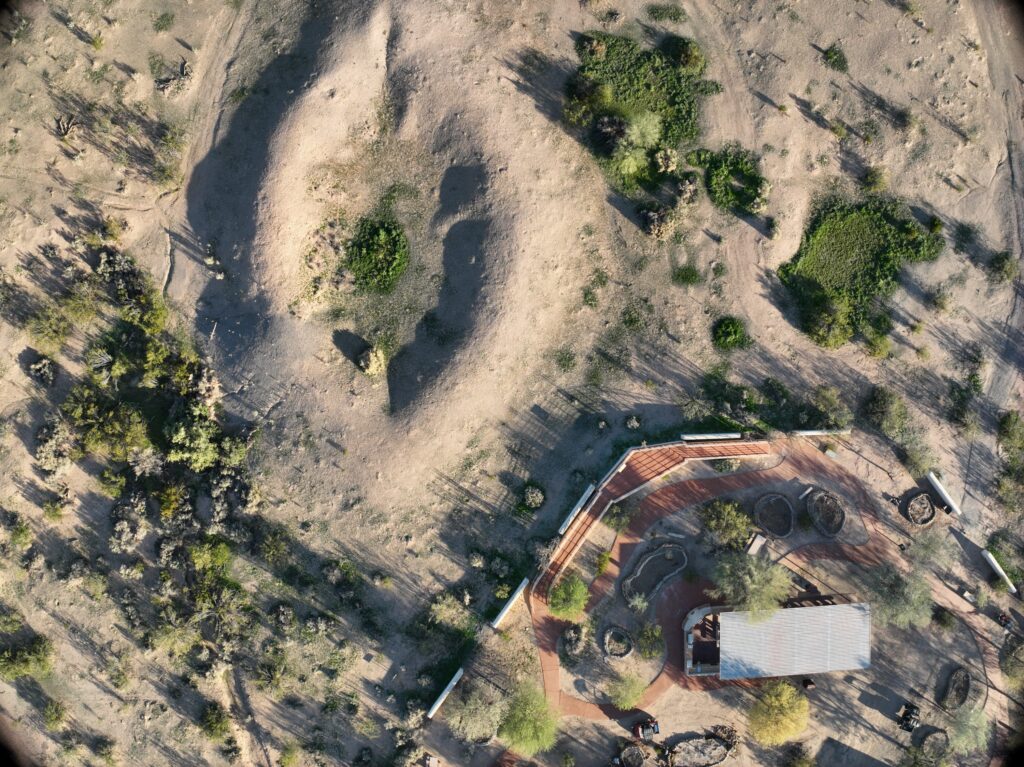
Located next to CAGR’s picnic area is the ball court, a large oval-shaped structure that was likely used as a recreational space by the ancestral Sonoran Desert People. According to the National Park Service, “archeologists have found over 200 oval-shaped, earthen-sided structures located in large Hohokam villages throughout southern and central Arizona” (source). The ball court at CAGR likely predates the Great House and was a space for the community to gather. Similarly to the Great House, visitors today are not permitted to enter the site but can see it from a viewing area near the picnic site.